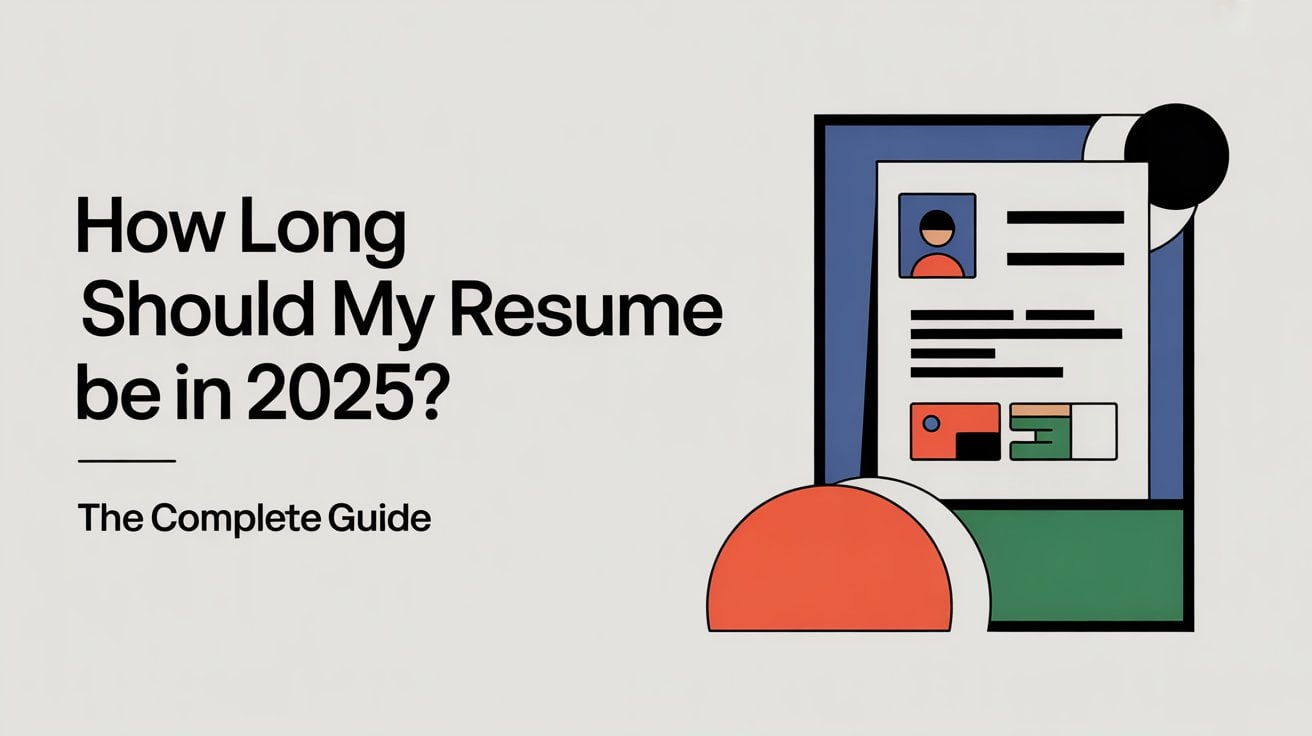
How Long Should My Resume Be in 2025? The Complete Guide
Your resume is still your most important career marketing tool, but the rules for what makes a good resume continue to evolve. With AI-powered applicant tracking systems (ATS), remote-first jobs, and a highly competitive global job market, the question “How long should my resume be in 2025?” has become more relevant than ever. In this article, we’ll break down the ideal resume length, explore how it varies by career stage, and share strategies to make your resume impactful without overwhelming hiring managers.
The One-Page Resume Debate
For decades, the one-page resume has been the gold standard, especially for early-career professionals. Recruiters value brevity, and studies show they spend only 7–10 seconds on an initial scan. In 2025, a one-page resume remains ideal if:
- You have less than 10 years of work experience.
- You’re applying for entry-level or mid-level roles.
- You want to make a strong, concise first impression.
When a Two-Page Resume Works Best
A two-page resume is increasingly acceptable, especially for professionals with diverse skills. In fact, research suggests recruiters often prefer a two-page resume for candidates with over 10 years of experience because it gives room to showcase career highlights. Use two pages if:
- You’re in a senior or specialized role.
- You’ve held multiple positions within the same company.
- You have publications, certifications, or projects worth highlighting.
Three Pages or More: Rare but Possible
While three pages might sound excessive, some professionals in academia, research, or executive leadership need that space. A curriculum vitae (CV), often required in academia, can span multiple pages. In 2025, three pages may be acceptable for:
- Professors, researchers, or scientists.
- Executives with decades of experience.
- Creative professionals showcasing a portfolio.
How Recruiters View Resume Length in 2025
Hiring managers in 2025 value quality over quantity. A concise, keyword-optimized resume tailored to the job description is far more effective than a lengthy one. Recruiters also appreciate formatting that makes scanning easier, such as:
- Bullet points instead of dense paragraphs.
- Clear section headings.
- Strategic use of white space.
Applicant Tracking Systems (ATS) and Resume Length
ATS software is more advanced in 2025, but it still prioritizes keyword relevance and structure over length. A resume that is too short may lack the necessary keywords, while an overly long one may dilute impact. Aim for:
- Including job-specific keywords naturally.
- Keeping descriptions achievement-focused.
- Using consistent formatting that ATS can read easily.
Industry Differences in Resume Expectations
Resume length expectations vary by industry:
- Tech & Startups → Prefer one page with key skills highlighted.
- Academia & Research → Multi-page CVs are the norm.
- Creative Fields → Portfolios may replace lengthy resumes.
- Corporate Roles → Two pages for experienced professionals are widely accepted.
Resume Length for Entry-Level Candidates
If you’re just starting out, one page is best. Focus on:
- Education, internships, and projects.
- Volunteer or leadership experiences.
- Key technical or transferable skills.
Resume Length for Mid-Level Professionals
At the mid-level, you likely have more to showcase. A two-page resume can highlight:
- Career progression.
- Key achievements with metrics (e.g., “Increased sales by 25%”).
- Specialized certifications or training.
Resume Length for Executives and Senior Leaders
Executives often benefit from a two-page resume, sometimes extending to three if necessary. Focus on:
- Leadership accomplishments.
- P&L responsibility, global projects, or board experience.
- Strategic contributions to growth or transformation.
How to Trim Your Resume Without Losing Impact
If your resume feels too long, use these strategies:
- Cut outdated roles beyond 15 years.
- Remove irrelevant details (e.g., high school achievements).
- Replace long descriptions with bullet-point achievements.
- Focus on measurable results rather than tasks.
Formatting Tricks to Save Space
Proper formatting can make a resume look shorter without cutting content:
- Adjust margins slightly.
- Use a professional but compact font (e.g., Calibri, Arial).
- Limit bullet points to 5–6 per role.
- Group similar experiences under one heading.
The Role of Cover Letters in Resume Length
Some candidates try to include everything on their resume, but a well-written cover letter can offload details like career motivation or personal story. In 2025, cover letters are still useful for:
- Explaining career gaps.
- Highlighting alignment with company culture.
- Adding context to key achievements.
Resume Trends in 2025: What’s Changing
Several resume trends are shaping 2025 hiring practices:
- Hybrid Resumes → Blending chronological and skills-based formats.
- Digital Portfolios → Links to online work samples.
- Video Resumes → Supplementing, not replacing, traditional resumes.
- AI Resume Scanning → Increasing emphasis on keyword accuracy.
Should You Use AI to Shorten Your Resume?
AI-powered resume builders and editing tools can help cut fluff while retaining impact. However, in 2025, recruiters caution against fully AI-generated resumes. Instead, use AI for:
- Polishing language.
- Optimizing for keywords.
- Ensuring consistency in formatting.
Common Resume Length Mistakes to Avoid
- Cramming everything into one page when more space is needed.
- Overloading with jargon instead of clear results.
- Repetition of responsibilities across multiple roles.
- Excessive design elements that ATS can’t read.
Global Resume Length Standards in 2025
Resume expectations differ globally:
- US & Canada → 1–2 pages max.
- Europe → 2 pages standard, CVs common.
- Asia → Often detailed resumes, but 1–2 pages preferred for corporate roles.
- Australia & NZ → 2–3 pages acceptable.
Final Tips to Decide Resume Length
When unsure, follow these guiding rules:
- Entry-level → Stick to 1 page.
- Mid-level → Aim for 1–2 pages.
- Senior-level/Executive → 2–3 pages if needed.
- Always focus on clarity, keywords, and achievements.
Conclusion: The Right Resume Length for You in 2025
There’s no one-size-fits-all answer to resume length. The ideal length depends on your experience, industry, and career stage. In 2025, the rule of thumb is to keep it concise, relevant, and results-driven. A recruiter would rather read two strong pages than one crammed or vague page.
Your resume is your personal marketing tool, so make every word count.
Call-to-Action:
Ready to make your resume stand out in 2025? Start by reviewing your current resume and trimming unnecessary details. Focus on accomplishments, tailor for each job, and ensure it’s ATS-friendly. If you’re serious about landing your dream job, consider professional resume review services or AI-assisted resume optimization to gain a competitive edge.